
Why CBAM Is Straining the Relationship Between Producers and Importers
Published on
No items found.


When the EU introduced the Carbon Border Adjustment Mechanism (CBAM), the policy intent was straightforward: ensure that imported goods face a carbon cost equivalent to that paid by EU producers under the Emissions Trading System, and in doing so reduce the risk of carbon leakage while encouraging lower-emissions production globally.
What has proven far more complex is not the principle of CBAM, but the way it is being implemented across real supply chains, where producers and importers are being asked to coordinate on carbon data in ways they never previously had to.
CBAM is often described as a reporting obligation, but in practice it has become a test of how well producers and importers can work together under pressure, with incomplete systems, unclear ownership of data, and growing financial consequences attached to getting it wrong.
A shared obligation built on unequal footing
Under CBAM, importers are legally responsible for submitting emissions data for the goods they bring into the EU, but that data must be generated by producers, calculated at installation level, and aligned with EU-defined methodologies that many non-EU installations have never had to follow before.
From the importer’s perspective, this creates an immediate dependency on suppliers for information that is both time-sensitive and commercially material, while still leaving the importer exposed if that information is late, incomplete, or ultimately unverifiable.
From the producer’s perspective, CBAM introduces a new category of customer demand that is operationally complex, methodologically unfamiliar, and often poorly coordinated, with multiple buyers requesting similar data in different formats and on different timelines, sometimes with little clarity on how that data will be used or protected once shared.
Neither side is failing in its role, but both are operating within a structure that assumes a level of coordination and standardisation that does not exist yet.
A different way to approach the problem: enter CarbonChain Connect
Sign up to CarbonChain Connect
Adam Hearne, CEO & Co-Founder sees this as an opportunity to create the most effective product yet that helps both sides of the trade.
“We’re creating the backbone for carbon emissions data. A shared infrastructure where producers and importers meet, share data reliably, and scale with commercial relationship with confidence.”
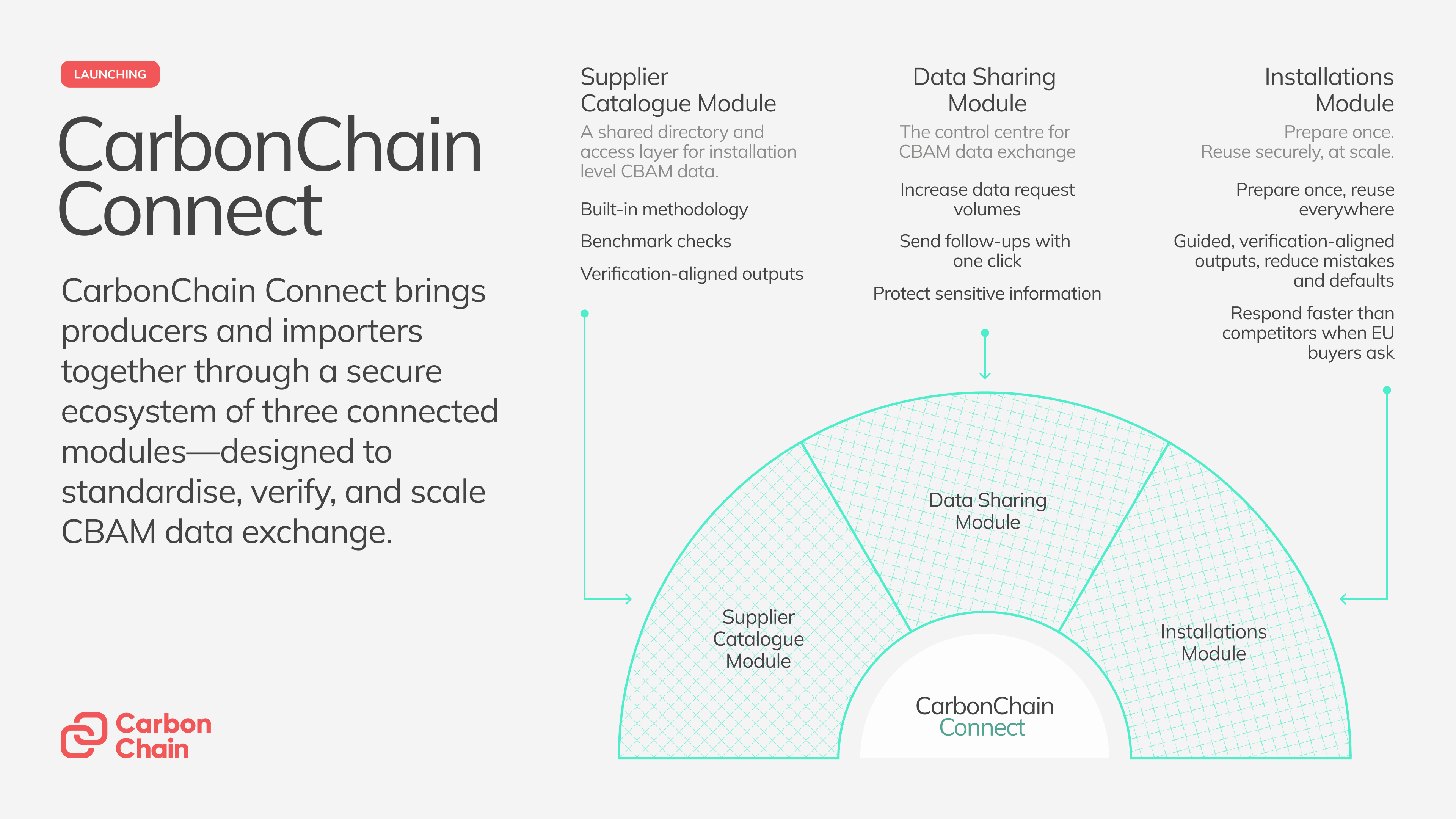
CarbonChain Connect is a consolidation of our end-to-end CBAM compliance capabilities. We offer a suite of three modules, that empower importers and producers to manage CBAM compliance under one, comprehensive platform. When you sign-up to CarbonChain Connect, you get access to three modules -
1. Supplier Catalogue Module: This is CarbonChain’s shared infrastructure for installation-level CBAM data. It lets installation operators and buyers manage, validate, and exchange supplier emissions data in one place, replacing manual outreach with a central workflow.
Explore Supplier Catalogue Module
2. Data Sharing Module: Built for companies operating in commodity supply chains, this is the control centre for exchanging CBAM datasets with the companies they buy from (upstream) and sell to (downstream). It’s built to help increase data request volume and acceptance by making requests clearer, follow-ups easier, and access rules transparent — without losing control of sensitive information.
And, the newly launched,
3. Installations Module: Built for producers responding to CBAM data requests from multiple EU customers, the Installations module lets you prepare your CBAM dataset once and share it securely with everyone - through a guided, verification-ready workflow that reduces errors and rework. For importers, it gives a consistent, structured way to access the data they need with less friction and greater confidence ultimately creating trust that is needed to take them through to verification over a five-year period.
Explore the Installations Module
We now know that the underlying issue CBAM exposes is not a lack of emissions expertise, but the lack of a shared system that allows producers to generate CBAM-ready data once, manage it over time, and share it consistently with multiple customers, while allowing importers to request, receive, and rely on that data without constant manual intervention.
The importer reality: accountability without control
For importers, CBAM responsibility sits awkwardly between sustainability, procurement, compliance, and finance, all of which depend on emissions data they do not produce themselves.
Many importers find themselves chasing dozens or hundreds of suppliers for information that arrives in spreadsheets, PDFs, or bespoke templates, each requiring interpretation, manual checks, and follow-up questions before it can be used with confidence.
As CBAM moves closer to financial liability, this challenge intensifies, because missing or low-quality data no longer just affects reporting accuracy, but directly translates into default values, higher costs, and uncertainty in forecasting and contracting.
Importers are expected to manage this risk, but without shared systems they are often left assembling a patchwork of supplier responses that is fragile by design.
As Nick Ogilvie, Product Manager and CBAM Lead at CarbonChain, puts it:
“CBAM only becomes manageable when emissions data stops being treated as a one-off reporting output and starts being treated as shared infrastructure between producers and importers.”
The producer reality: repeated requests and rising pressure
Producers, particularly those supplying multiple EU customers, often experience CBAM as a steady accumulation of overlapping demands rather than a single regulatory exercise. Beyond the requests, we are seeing that both producers aren’t necessarily always aware on what’s needed operationally to report the correct data for and importers not always asking for the correct information in the fist place.
Installation-level data is often prepared uniquely to answer different customer requests, often under tight deadlines and with limited internal guidance and in some cases in misalignment to the EU CBAM’s reporting methodology, emissions and benchmarks calculation requirements, and verification expectations.
At the same time, producers are acutely aware that the quality and timeliness of their CBAM data can influence customer relationships, commercial competitiveness, and even access to the EU market, which raises the stakes of getting it wrong, while offering limited support on how to get it right efficiently.
For many producers, the frustration is not the requirement to provide data, but the absence of a clear, reusable way to do so with the confidence to communicate authoritative figures and satisfying every customer interaction.
Where the relationship starts to strain
The tension between producers and importers does not come from unwillingness on either side, but from the fact that CBAM has effectively turned emissions data into a shared operational dependency without providing shared infrastructure to manage it.
Importers push harder as deadlines and costs approach, while producers struggle to respond at scale using tools and processes that were never designed for this level of repetition or scrutiny.
Over time, these dynamics risk eroding trust, as importers question data quality and producers feel exposed by ad-hoc data sharing, even when both are acting in good faith.
What this means at scale and commercially
At scale, the absence of shared infrastructure turns CBAM into a bottleneck, where manual coordination breaks down, procurement decisions are influenced by data availability rather than true emissions performance, and both sides absorb growing operational cost simply to stand still. We’re seeing a rise in individuals offering CBAM consultancy and hedging strategies but while valuable, it does not solve the fundamental problem of CBAM data infrastructure.
Commercially, this matters because CBAM is no longer an abstract compliance exercise, but a factor in pricing, supplier selection, contract negotiations, and margin management, meaning that inefficient data exchange increasingly shows up in real financial outcomes.
From strained relationships to shared systems
The European Commission’s CBAM introduced a shared regulatory obligation — but no shared system to manage it. CarbonChain Connect provides that infrastructure, allowing producers and importers to implement EU requirements reliably and at scale. As the UK develops its own CBAM framework, the need for durable carbon data infrastructure will only accelerate.
CBAM is changing the relationship between producers and importers whether they are ready or not, because it requires ongoing collaboration on carbon data that sits at the intersection of compliance, operations, and commercial decision-making.
The strain many companies feel today is not a sign that CBAM is unworkable, but a signal that the underlying systems have not yet caught up with the role emissions data is now expected to play. Those who invest early in shared infrastructure will not only find CBAM easier to manage but will also be better positioned as carbon data becomes a permanent feature of global commodity trade, rather than a temporary regulatory hurdle.
No items found.
Need help measuring your Scope 3 emissions for your reporting? Get in touch with CarbonChain today.
Schedule a call
See our full FY20-21 emissions report

Save this guide as a PDF
Get in touch today to book a demo and get a sample report for your needs.